

Project Management for Data Centers is a specialized field — different from PM for software or conventional construction projects because it simultaneously combines multiple complex technical disciplines, strict standards, and very high go-live time pressure. First, let’s look at the overall structure:
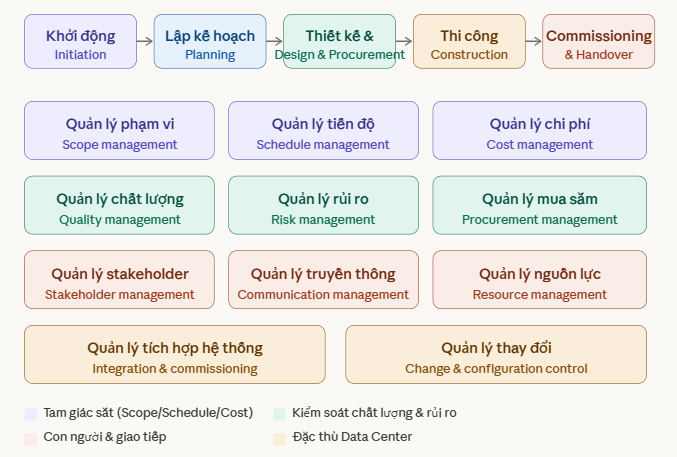
Data Center project management consists of 5 lifecycle phases and 10 knowledge areas, of which the last 2 are unique to Data Centers and are often overlooked by PMs from other industries. Now, let’s go deeper into each part.
Phase 1 — Project Initiation
Project Charter and Business Case
The most important initiation document is the Project Charter — an official document authorizing the PM and defining their authority. For a Data Center project, the Charter must include:
- Measurable project objectives: “Complete a 5MW Tier III Data Center, achieve commercial power by December 2026, CAPEX not exceeding 25 million USD”
- High-level scope: civil, MEP, IT infrastructure, commissioning
- Core constraints: whether land is secured, whether power supply is committed by EVN, Tier target
- Known initial risks: long equipment lead times (UPS, chillers, gensets may take 9–18 months)
- Key stakeholder list and approval authority
Early Stakeholder Identification — a commonly overlooked factor
Data Center projects have more stakeholders than most other project types. They must be identified early:
- Internal: Board of Directors, CFO, CTO, future Operations team
- Government authorities: EVN, Department of Construction, Fire Protection Authority, Department of Information & Communications, Ministry of Planning & Investment (if FDI)
- Technical third parties: Design consultant, General Contractor, MEP sub-contractors, equipment vendors
- Anchor customers (if any): especially critical because they often have specific technical requirements that impact the design
Phase 2 — Planning
This is the most time-consuming phase and determines the success or failure of the entire project. Experienced PMs know that one week of detailed planning can save one month of crisis handling later.
Work Breakdown Structure (WBS) specific to Data Centers
The WBS of a Data Center project must be detailed enough to track each work package. A typical structure:
DC Project
1. Civil & Structural
1.1 Site preparation & piling
1.2 Foundation & structure
1.3 Raised floor & containment
1.4 Facade & finishes
2. Electrical systems
2.1 HV/MV substation
2.2 UPS & battery systems
2.3 Generators & ATS/AMF
2.4 LV distribution (PDU, busway)
2.5 Earthing, lightning, TVSS
3. Mechanical systems
3.1 Chiller plant & cooling tower
3.2 CRAC/CRAH units
3.3 Aisle containment
3.4 Liquid cooling (for AI Data Centers)
4. Fire protection & BMS
4.1 FM200/Novec suppression
4.2 Aspirating smoke detection
4.3 BMS integration
4.4 Access control & CCTV
5. IT infrastructure (if in scope)
5.1 Structured cabling
5.2 Network equipment
5.3 DCIM system
6. Commissioning & certification
6.1 Factory Acceptance Test (FAT)
6.2 Site Acceptance Test (SAT)
6.3 Integrated System Test (IST)
6.4 Tier certification audit
Master Schedule and Critical Path
A key difference between Data Centers and typical construction projects: long-lead equipment drives the critical path, not construction activities.
Typical equipment delivery lead times (from order date to site arrival):
| Equipment | Typical Lead Time |
| Large UPS (500kVA+) | 9–14 months |
| Generator (1MW+) | 10–16 months |
| Chiller (centrifugal) | 12–18 months |
| 110kV/22kV transformer | 8–14 months |
| MV switchgear | 8–12 months |
| CRAC/CRAH | 4–8 months |
| ATS/AMF | 6–10 months |
Practical implication: the PM must approve purchase orders for UPS and Generators as early as month 2–3 of the project, while the MEP design is not yet finalized. This is critical — a 1-month delay in ordering can push go-live by 3–6 months.
1. Scope Management — detailed
Scope creep — the biggest risk in Data Center projects
Data Center projects are particularly prone to scope creep because:
- Anchor customers add technical requirements after design completion
- The owner upgrades Tier from III to IV mid-project
- EVN changes connection requirements, forcing substation redesign
- Unexpected geotechnical issues during excavation require foundation redesign
Scope control tool: Change Control Board (CCB) with a mandatory Change Request (CR) process. All changes must go through: CR submission → impact assessment (cost, schedule, quality) → CCB approval → baseline update → implementation. There is no “small change” in Data Centers — a minor relocation of a substation can require a complete cable routing redesign.
2. Schedule Management — detailed
4 tools PM must use in parallel
Critical Path Method (CPM): Identifies the longest sequence of tasks determining project duration. In Data Centers, the critical path often runs through: HV substation → MV distribution → UPS → LV PDU → IT commissioning. PMs must monitor float for each critical activity weekly.
Resource leveling: Data Centers have peak labor demand during MEP construction — up to 200–400 workers in confined spaces. PMs must schedule by zones (electrical, mechanical, civil) to avoid conflicts.
Look-ahead schedule: A rolling 3-week schedule more detailed than the master schedule, updated weekly during construction meetings. All subcontractors must commit to it.
Milestone tracker: Key milestones must be tracked separately using RAG status (Red/Amber/Green). Typical milestones: Structure complete → MEP rough-in complete → Raised floor complete → First power on → Cold commissioning → Hot commissioning → Tier audit → Commercial Operations Date (COD).
Vietnam-specific schedule challenges
In Vietnam, common delays include: fire protection approval taking 3–6 months (must plan early), EVN power connection acceptance delayed 2–4 months, and building permits (GPXD) being more complex due to the specialized nature of Data Centers.
3. Cost Management — detailed
Typical CAPEX structure of a Data Center
A 5MW Tier III Data Center in Vietnam (Ho Chi Minh City) has a typical CAPEX breakdown:
| Category | Typical CAPEX Ratio |
| Civil & structural | 15–20% |
| Electrical systems (UPS, Gen, MV/LV) | 30–35% |
| Mechanical systems (Cooling) | 20–25% |
| Fire & security systems | 5–8% |
| IT & cabling infrastructure | 8–12% |
| Commissioning & certification | 2–4% |
| Project management & design | 5–8% |
| Contingency | 10–15% |
Note: a 10–15% contingency is realistic for this industry, not 5% as in typical projects. Data Centers have many uncertainties during construction.
Earned Value Management (EVM)
EVM is an integrated tool measuring both schedule and cost performance, especially critical for large Data Center projects:
- PV (Planned Value): Planned cost at the reporting point
- EV (Earned Value): Value of completed work
- AC (Actual Cost): Actual cost incurred
- CPI = EV/AC: Cost efficiency index. CPI < 1 = overspending
- SPI = EV/PV: Schedule efficiency index. SPI < 1 = behind schedule
In Data Center projects, EVM is particularly useful to detect issues with long-lead equipment early — if EV for UPS is below PV when equipment has not arrived, there is likely a vendor issue.
4. Quality Management — detailed
Data Center Quality Plan
A Data Center quality plan must include three layers of testing:
Factory Acceptance Test (FAT): Testing equipment at the vendor’s factory before shipment. Critical for UPS and Generators — includes functional testing, load testing, battery discharge, and transfer time tests. Discovering defects after delivery to Vietnam significantly increases cost.
Site Acceptance Test (SAT): Testing after installation on-site. Each system is tested independently: UPS (bypass, switching, battery), Generator (auto-start, load pickup), Chiller (startup, alarms).
Integrated System Test (IST) / Commissioning: The most complex test — validating the entire integrated system under simulated real-world scenarios. For Tier III, concurrent maintainability must be demonstrated. IST typically lasts 2–4 weeks.
Inspection & Test Plan (ITP)
ITP is critical — it defines inspection steps, responsible parties (Contractor/Consultant/Owner), acceptance criteria, and documentation. It must be approved before construction. No ITP = no basis for acceptance.
5. Risk Management — detailed
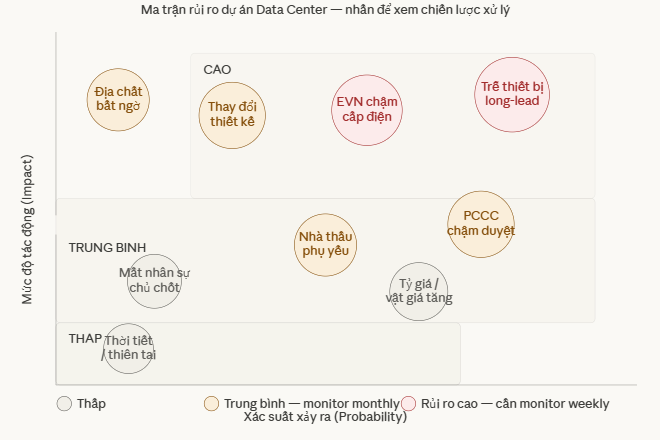
This is one of the most critical areas in Data Center PM. The diagram below shows a typical risk matrix:
Strategies for handling key risks
Long-lead equipment delay (High probability / Very high impact): Order 2–3 months earlier than needed, include delay penalties in contracts, maintain strong vendor relationships, request weekly updates from month 6, and prepare backup vendors if possible.
EVN power connection delay (High probability / High impact): Submit connection applications early, maintain good relationships with local EVN, plan temporary power solutions (gensets) for partial commissioning, and avoid committing go-live dates without written EVN confirmation.
Fire protection approval delay (High probability / Medium impact): Submit approval documents early, engage experienced consultants, and ensure complete documentation on first submission.
6. Procurement Management — detailed
Contracting strategies
Three common models:
Design-Bid-Build (DBB): Separate design and construction. Pros: better design control. Cons: longer duration, buildability risks.
Design-Build (DB): Single contractor. Pros: faster, clear responsibility. Cons: less design control.
EPCM: Owner purchases directly, PM manages. Best for large Data Centers.
Vendor qualification
Minimum criteria: 3–5 similar Data Center projects completed, in-house commissioning engineers, authorized service center in Vietnam, and verifiable references.
7. System Integration Management — the most critical DC-specific area
Why it is unique
Data Centers consist of multiple systems that must work seamlessly together:
- UPS must switch to battery within <10ms without affecting IT load
- Generator must start and transfer load within <20 seconds
- No overload or trip when generator takes load
- BMS must collect and prioritize alarms
- DCIM must integrate with BMS for real-time monitoring
Commissioning sequence — non-negotiable order
- Cold commissioning (no load)
- Hot commissioning (load bank)
- Integrated System Test (IST)
- Failure mode testing
- Tier audit
- Handover (documents, manuals, SOP)
- Performance period (30–90 days)
8. Reporting and Communication — practical tools
PM must maintain 4 types of reports:
Daily site report: manpower, progress, issues, deliveries, safety.
Weekly report: RAG status, EVM metrics, risks, look-ahead, actions.
Monthly dashboard: summary for executives.
Ad-hoc report: immediate reporting for critical issues.


